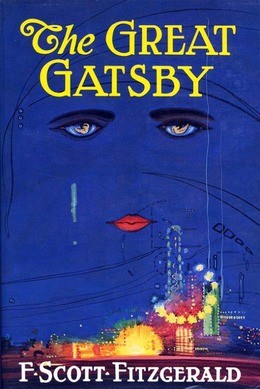

Martj9 ha recensito Il grande Gatsby di Francis Scott Fitzgerald
Forse sulla solitudine
4 stelle
"Non venne nessuno."
Ma Nick c'era. Lui c'è sempre stato.
"Non venne nessuno."
Ma Nick c'era. Lui c'è sempre stato.
This work is available for countries where copyright is Life+70.
In 1922, F. Scott Fitzgerald announced his decision to write "something new--something extraordinary and beautiful and simple + intricately patterned." That extraordinary, beautiful, intricately patterned, and above all, simple novel became The Great Gatsby, arguably Fitzgerald's finest work and certainly the book for which he is best known. A portrait of the Jazz Age in all of its decadence and excess, Gatsby captured the spirit of the author's generation and earned itself a permanent place in American mythology. Self-made, self-invented millionaire Jay Gatsby embodies some of Fitzgerald's--and his country's--most abiding obsessions: money, ambition, greed, and the promise of new beginnings. "Gatsby believed in the green light, the orgiastic future that year by year recedes before us. It eluded us then, but that's no matter--tomorrow we will run faster, stretch out our arms farther.... And one fine morning--" Gatsby's rise …
This work is available for countries where copyright is Life+70.
In 1922, F. Scott Fitzgerald announced his decision to write "something new--something extraordinary and beautiful and simple + intricately patterned." That extraordinary, beautiful, intricately patterned, and above all, simple novel became The Great Gatsby, arguably Fitzgerald's finest work and certainly the book for which he is best known. A portrait of the Jazz Age in all of its decadence and excess, Gatsby captured the spirit of the author's generation and earned itself a permanent place in American mythology. Self-made, self-invented millionaire Jay Gatsby embodies some of Fitzgerald's--and his country's--most abiding obsessions: money, ambition, greed, and the promise of new beginnings. "Gatsby believed in the green light, the orgiastic future that year by year recedes before us. It eluded us then, but that's no matter--tomorrow we will run faster, stretch out our arms farther.... And one fine morning--" Gatsby's rise to glory and eventual fall from grace becomes a kind of cautionary tale about the American Dream.
It's also a love story, of sorts, the narrative of Gatsby's quixotic passion for Daisy Buchanan. The pair meet five years before the novel begins, when Daisy is a legendary young Louisville beauty and Gatsby an impoverished officer. They fall in love, but while Gatsby serves overseas, Daisy marries the brutal, bullying, but extremely rich Tom Buchanan. After the war, Gatsby devotes himself blindly to the pursuit of wealth by whatever means--and to the pursuit of Daisy, which amounts to the same thing. "Her voice is full of money," Gatsby says admiringly, in one of the novel's more famous descriptions. His millions made, Gatsby buys a mansion across Long Island Sound from Daisy's patrician East Egg address, throws lavish parties, and waits for her to appear. When she does, events unfold with all the tragic inevitability of a Greek drama, with detached, cynical neighbor Nick Carraway acting as chorus throughout. Spare, elegantly plotted, and written in crystalline prose, The Great Gatsby is as perfectly satisfying as the best kind of poem. Source: www.feedbooks.com/book/5543/the-great-gatsby
"Non venne nessuno."
Ma Nick c'era. Lui c'è sempre stato.
"Non venne nessuno."
Ma Nick c'era. Lui c'è sempre stato.
I am pretty sure I read this long ago but this time I remembered virtually nothing about it. I picked this up as a second-hand paperback heavily highlighted by its previous owner(s), probably for a school assignment. All I really recalled was how the story was told from the point of view of a secondary character, Nick Carraway, who knows as little about the title character initially as we do and has to work out his attitude to all the principals as he meets them. What I was mainly interested in was the reputation it has had since its publication in 1925. The writing shows its age but I did notice the care the author took with each of the characters to establish a clear voice, and with the settings to help the reader imagine what it felt like to experience along with the characters. There are a few flourishes …
I am pretty sure I read this long ago but this time I remembered virtually nothing about it. I picked this up as a second-hand paperback heavily highlighted by its previous owner(s), probably for a school assignment. All I really recalled was how the story was told from the point of view of a secondary character, Nick Carraway, who knows as little about the title character initially as we do and has to work out his attitude to all the principals as he meets them. What I was mainly interested in was the reputation it has had since its publication in 1925. The writing shows its age but I did notice the care the author took with each of the characters to establish a clear voice, and with the settings to help the reader imagine what it felt like to experience along with the characters. There are a few flourishes of colloquial, non-academic speech I noticed and some passages of emotional description to enhance the mood, whether during a boozy party, a tense situation rising toward violence, or the deep melancholy at the end. Carraway is taken with his enigmatic friend Gatsby and we the readers have to work out how far to go in along the same direction, or to instead reject that point of view as we are presented with that character's flaws. All the characters are messed up in various ways and the social environment can also come in for criticism. This book was closer to a novella, with just the Carraway/Baker subplot against the main story with the two love triangles. I wasn't drawn in as much with this as with the novels I enjoy the most but appreciate the chance to renew my acquaintance with this 99-year old standard.
I was (like many) forced to read The Great Gatsby in high school, though I wish I hadn't as I was incapable of truly appreciating it at the time.
As others have mentioned, Fitzgerald's prose is unbelievable. In just a few words he can paint vivid imagery in your mind with layers of depth and analysis to accompany the emotions. The story and characters are beautifully written with a natural complexity that avoids the cliche 'good guys' & 'bad guys' we typically experience.
Just from my perspective alone, I found many themes and interpretations to the story which resonated with me, just to name a few:
And those are just the themes that resonated with me! There are a billion different things to take from this book, and I feel it's probably worth re-reading every few years as I'm sure there's more to get from it as we develop in life and stumble on different issues that resonate with us.
Watching the 2013 movie after finishing the book, I'm a fan.