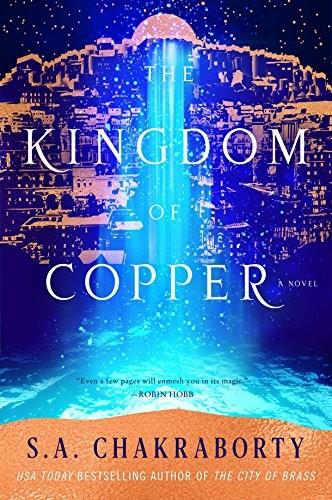
Nahri’s life changed forever the moment she accidentally summoned Dara, a formidable, mysterious djinn, during one of her schemes. Whisked from her home in Cairo, she was thrust into the dazzling royal court of Daevabad—and quickly discovered she would need all her grifter instincts to survive there.
Now, with Daevabad entrenched in the dark aftermath of a devastating battle, Nahri must forge a new path for herself. But even as she embraces her heritage and the power it holds, she knows she’s been trapped in a gilded cage, watched by a king who rules from the throne that once belonged to her family—and one misstep will doom her tribe..
Meanwhile, Ali has been exiled for daring to defy his father. Hunted by assassins, adrift on the unforgiving copper sands of his ancestral land, he is forced to rely on the frightening abilities the marid—the unpredictable water spirits—have gifted …
Nahri’s life changed forever the moment she accidentally summoned Dara, a formidable, mysterious djinn, during one of her schemes. Whisked from her home in Cairo, she was thrust into the dazzling royal court of Daevabad—and quickly discovered she would need all her grifter instincts to survive there.
Now, with Daevabad entrenched in the dark aftermath of a devastating battle, Nahri must forge a new path for herself. But even as she embraces her heritage and the power it holds, she knows she’s been trapped in a gilded cage, watched by a king who rules from the throne that once belonged to her family—and one misstep will doom her tribe..
Meanwhile, Ali has been exiled for daring to defy his father. Hunted by assassins, adrift on the unforgiving copper sands of his ancestral land, he is forced to rely on the frightening abilities the marid—the unpredictable water spirits—have gifted him. But in doing so, he threatens to unearth a terrible secret his family has long kept buried.
And as a new century approaches and the djinn gather within Daevabad's towering brass walls for celebrations, a threat brews unseen in the desolate north. It’s a force that would bring a storm of fire straight to the city’s gates . . . and one that seeks the aid of a warrior trapped between worlds, torn between a violent duty he can never escape and a peace he fears he will never deserve.
La precisione con cui viene raccontata l'ingiustizia in questo libro è dolorosa. Che bello.
Forse un po' lento in alcuni punti (erano davvero necessarie 640 pagine? E il terzo libro è ancora più lungo, sono spaventato dai libri enormi). Tuttavia, i temi e la politica - o meglio: i temi politici - sono articolati, difficili, per ora senza risposte giuste e solo rabbia e dolore e dubbi. Non so neanche se sperare che si risolvano nell'ultimo libro. Si possono avere risposte giuste di fronte a un sistema di sfruttamento, vendetta e rabbia incistate?
Book 2 in a series, and a wonderful fleshing out of things that were introduced in City of Brass. The politics get more complicated and feel more real as a result, the focus characters get more developed, and the city feels more alive. It feels like such a sharp analysis of the ways resentments and conflicts get stuck and self-feeding that I kept seeing real-world stories reflected in it. But it's never as narrow as an allegory for any one thing in the real world, it's much more an exploration of the whole type of thing.
It does have weaknesses: never getting Ghassan's perspective lets him feel like a cartoon villain, and never getting Muntadhir's makes his growth feel lurching and unpredictable... which in fairness it probably would have done to people around him too. And where the ending of City of Brass deftly managed to stand on its …
Book 2 in a series, and a wonderful fleshing out of things that were introduced in City of Brass. The politics get more complicated and feel more real as a result, the focus characters get more developed, and the city feels more alive. It feels like such a sharp analysis of the ways resentments and conflicts get stuck and self-feeding that I kept seeing real-world stories reflected in it. But it's never as narrow as an allegory for any one thing in the real world, it's much more an exploration of the whole type of thing.
It does have weaknesses: never getting Ghassan's perspective lets him feel like a cartoon villain, and never getting Muntadhir's makes his growth feel lurching and unpredictable... which in fairness it probably would have done to people around him too. And where the ending of City of Brass deftly managed to stand on its own at the same time as leaving a clear opening for a sequel, the end of this one doesn't stand on its own at all.
I'm very glad that the teaser for Empire of Gold makes clear that we'll get some chapters from Manizheh's perspective, and I hope it also gives Zaynab a bit more space, since she feels a bit like a plot mechanism so far. But I couldn't put this volume down and it took some self control to not launch directly into the next.