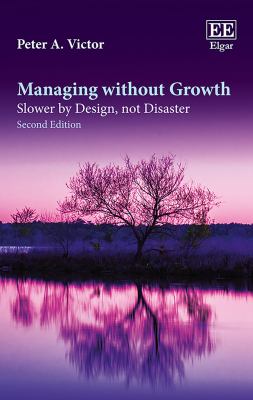
This book explains why long-term economic growth is infeasible, and why, especially in advanced economies, it is also undesirable. Simulations based on real data show that managing without growth is a better alternative. The book tells how the recent idea of economic growth emerged from the idea of progress, itself only a few hundred years old. Many reasons for questioning growth are given based on an extensive review of the data as well as on conceptual and methodological considerations. The experience of growth in several countries is documented, compared and …
(0 recensioni)
This book explains why long-term economic growth is infeasible, and why, especially in advanced economies, it is also undesirable. Simulations based on real data show that managing without growth is a better alternative. The book tells how the recent idea of economic growth emerged from the idea of progress, itself only a few hundred years old. Many reasons for questioning growth are given based on an extensive review of the data as well as on conceptual and methodological considerations. The experience of growth in several countries is documented, compared and found wanting. Possibilities for managing without growth in high income economies are simulated with a new, comprehensive systems model with many novel features. Three 50 year scenarios are compared: a base case, an ambitious greenhouse gas reduction scenario, and a sustainable prosperity scenario with broader environmental objectives, reduced income inequality, shorter working hours and the cessation of economic growth. The book closes with a review of policies to make this scenario a reality.
Brossura, 413 pagine
lingua English
Pubblicato il 01 Gennaio 2019 da Edward Elgar Publishing.
Mostra di più
- ISBN:
- 978-1-78536-739-7ISBN copiato!
- Numero OCLC:
- 1084352980
Carica dati
Argomenti
- Economic development, environmental aspects
- Economic development, social aspects